Why Your Pinehurst "Four-Bedroom" Might Legally Be a Three
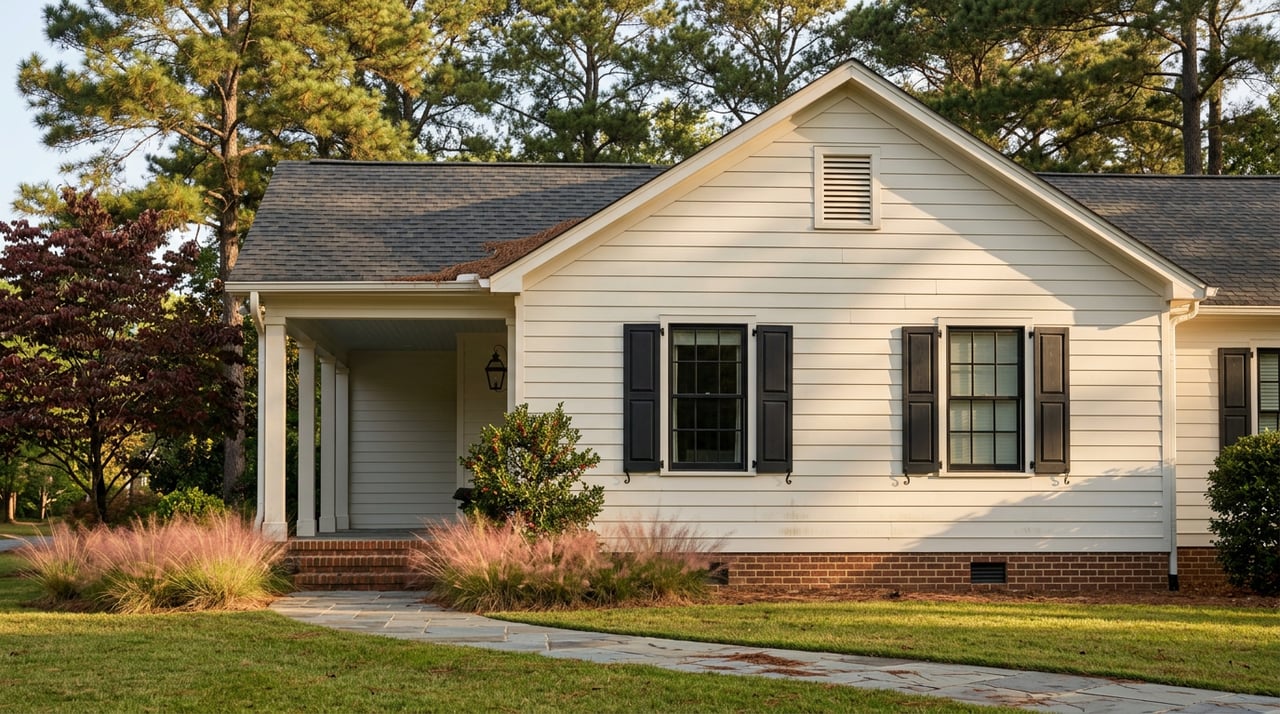
Picture a resale in Pinewild Country Club. Brick exterior, golf course view, four bedrooms on the listing sheet. One of them used to be a study. It has a closet now, a window, room for a bed. Everything about it says bedroom. Then somewhere between the accepted offer and closing, someone pulls the septic permit and finds the county only ever authorized the house for three.
That single document, filed decades ago with the Moore County Health Department, still controls what the home can legally be called today. Not the floor plan. Not the tax card. Not the fact that a family has slept in that room for fifteen years. The septic permit.
Most buyers moving into Pinehurst's golf communities have never had to think about this, because most of what they're coming from sits on municipal sewer. Pinehurst is different in ways that matter here, and the difference shows up exactly when a family is trying to finance a home, add a bedroom, or put in a pool.
North Carolina treats a septic-served home's bedroom count as a regulatory fact, not a marketing choice. The state's Real Estate Commission has said plainly that a broker may not advertise more bedrooms than a septic permit allows, even with a disclaimer buried in the listing remarks. Calling a permitted three-bedroom system a "four-bedroom home with bonus room" doesn't solve the problem. It just adds a paper trail showing the agent knew.
The reasoning is not bureaucratic caution for its own sake. Under North Carolina's sewage flow standards, a system is engineered around a specific number: 120 gallons of daily flow per bedroom, with a minimum of 240 gallons per day built in for the first two. Every bedroom beyond that adds another 120 gallons the drain field has to absorb. The permit is not a label. It is the load-bearing calculation for what the ground underneath the house can actually process. Convert an office into a fourth bedroom without updating the permit, and you have not added square footage. You have asked a system designed for three people's worth of wastewater to handle four.
That has real consequences at the closing table. Lenders and appraisers who catch the mismatch will typically value the home against three-bedroom comparables, not four, which can open a financing gap the buyer has to cover in cash or renegotiate. It is also why North Carolina law puts the burden on the listing agent directly, under General Statute 93A-6, to take reasonable steps to confirm septic capacity before advertising a bedroom count at all.
A lot of Pinehurst's most sought-after golf-community housing stock came out of the golf-course construction boom of the 1990s: Pinewild Country Club, which traces back to 1991, along with McLendon Hills, Talamore, National Golf Club, and the Pinehurst No. 6 area. Properties on larger lots outside the Village's walkable core have long depended on private wells rather than tying into town water, a pattern well-drilling companies serving the area describe as a defining feature of building or buying beyond the Village center. A private well is typically paired with a private septic system, which means the permit filed when the house was built is still the operative legal ceiling on bedroom count today, decades later.
Compare that to a resale inside the Village core or in a neighborhood connected to Moore County's municipal system, where the bedroom question is governed by building code rather than a soil-based permit. The distinction rarely comes up until a buyer is comparing two houses that look identical on paper and only one of them carries this hidden constraint.
Here is the part that surprises most people, including some who have lived in the Sandhills for years. The region's deep, fast-draining sandy soil sounds like an asset. Rain disappears quickly. No standing water, no mud. For a septic system, that speed is exactly the liability regulators are guarding against. Wastewater can reach groundwater before it has been fully treated, because the sand simply does not hold it in the soil layer long enough to do the filtering job a septic system depends on.
That is why Moore County requires a licensed soil scientist to evaluate a site before any septic permit is issued, and why the setbacks are as strict as they are:
| Component | Required setback |
|---|---|
| Septic tank to well | 50 feet minimum |
| Drain field or soil absorption system to well | 100 feet minimum |
| Animal waste area to well | 100 feet minimum |
On a generous golf-course lot, those distances are usually easy to accommodate. On a smaller in-fill parcel, or a lot where a pool, guest house, or added bedroom is being planned, those same setbacks can eat into the buildable footprint fast. A buyer who assumes Sandhills sand means simple, forgiving ground is starting from the wrong premise. The sand is exactly why the county holds the line.
There is a second, quieter issue stacking on top of the permit question. Homes built during Pinehurst's golf-community construction boom are now roughly twenty-five to thirty-five years old, old enough that original plumbing, aging well pumps, and first-generation septic components are reaching the point where failure or forced upgrade becomes likely rather than hypothetical. A system that was properly permitted for three bedrooms when the house was built has also been in continuous service for a quarter century or more, which means the conversation buyers need to have is not only "what does the permit say" but "what condition is the permit describing."
This is the moment retirees and relocating professionals are most likely to run into both problems at once: a home whose legal bedroom count is smaller than its floor plan suggests, sitting on a system old enough to need real attention regardless of what the paperwork allows.
If you are buying in a Pinehurst golf community on private well and septic, the request is specific and it is reasonable to make before you write an offer:
If you are selling, or handling a sale as an heir or trustee for a golf-community property, the obligation runs the other direction. Locate the original permit before you list. If it cannot be found, the honest move is disclosing that the investigation did not turn one up, rather than advertising the bedroom count you assume is correct. Buyers' agents are watching for this mismatch, and the Real Estate Commission's own guidance makes clear that silence is not a safe harbor once a licensee knows or should reasonably know the numbers do not line up.
Does this apply if the house is on municipal water and sewer? No. The septic permit ceiling only governs homes on private septic systems. A property connected to Moore County's municipal sewer is governed by building code occupancy standards instead, which is one more reason to confirm which system a specific home actually uses rather than assuming based on the neighborhood.
What if the original permit genuinely cannot be located? It happens on older homes. County practice allows advertising the existing bedroom count with a disclosure that no permit was found, rather than silently assuming the higher number is safe to market.
Does a septic inspection at closing catch this automatically? A standard point-of-sale inspection verifies the system is functioning and checks permit records, but it will not always catch a converted room unless someone specifically asks the inspector to compare the physical layout against the permitted bedroom count. That comparison is worth requesting by name.
A house on a quiet fairway lot rarely announces this kind of limit on its own. It takes someone who knows to ask the county for the actual permit, read the setbacks against the actual lot, and treat a thirty-year-old system with the seriousness its age deserves. That is the kind of groundwork Bill Sahadi has spent more than two decades doing across Pinehurst's golf communities, and it is exactly the conversation worth having before an offer goes in or a listing goes live. Let's Connect.
Whether you’re buying your first home, selling a trust property, or navigating a probate sale, my goal is always the same: to provide honest guidance, strong advocacy, and a smooth experience from beginning to end. Real estate is about people, not just properties. I would be honored to help you take your next step.
BILL SAHADI
1140 US HWY 1 SOUTH SOUTHERN PINES, NC 28387